11pm, and I’m doing the math I don’t want to do. If the tools keep improving at this rate, what does my skill set look like in three years? What’s actually still mine?
1am the next night, I’m wiring up an agent pipeline for a side project with my kids, grinning like a nerd, because something that would’ve taken a weekend I didn’t have now takes an hour I did.
Same person. Two nights apart. Both real.
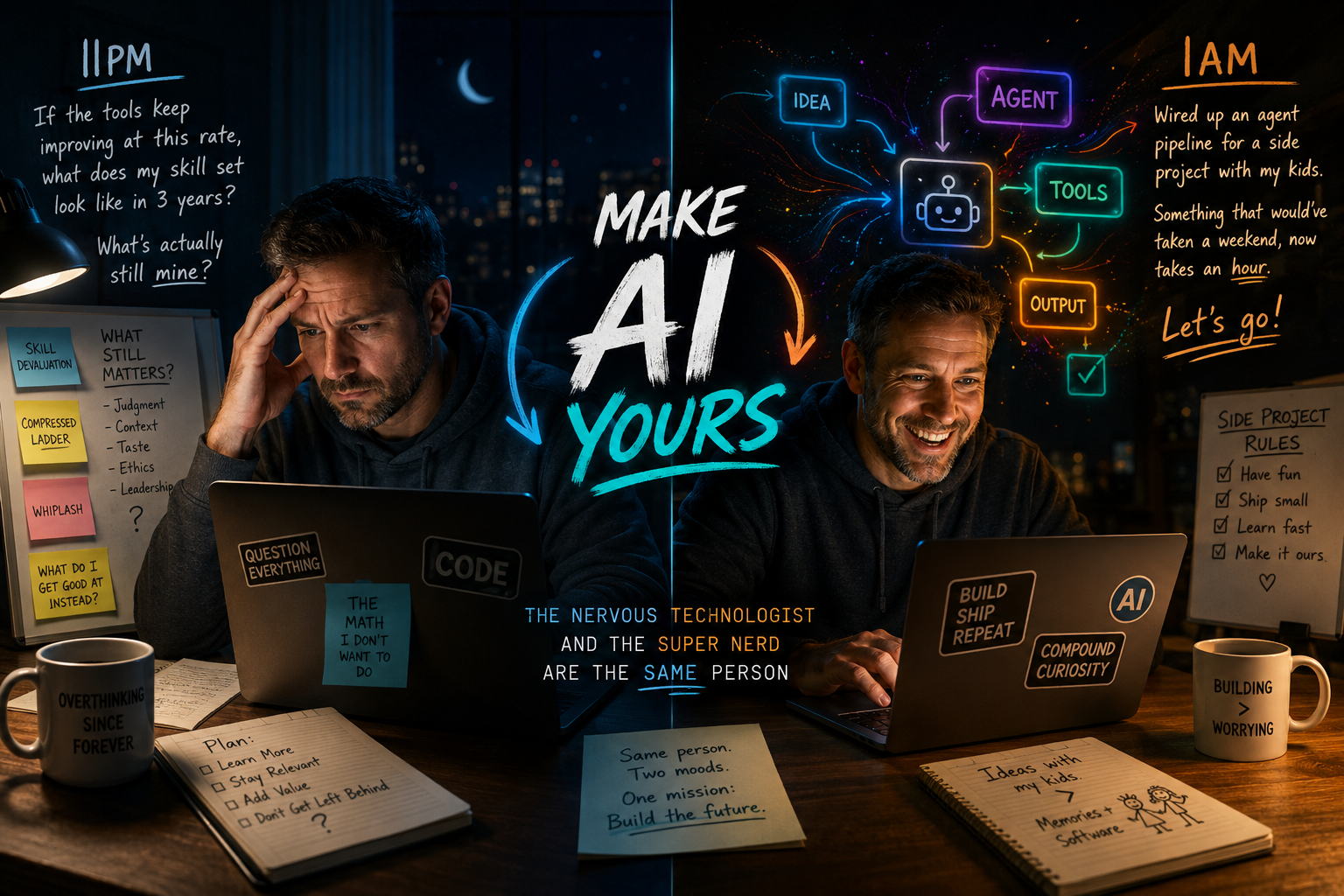
I used to think of these as two different reactions: the nervous technologist and the eager builder, two camps arguing past each other online. I don’t think that anymore. It’s not two camps. It’s one person, engaging with the same AI ecosystem in different ways, on different nights, sometimes in the same hour. And I’ve stopped trying to figure out which one is the “correct” read on where we are. They’re both correct. They’re just correct about different things.
The Fear Is Real
I don’t think the anxiety is irrational, and I’m suspicious of anyone who tells you it is.
Every technology wave gets the same reassurance: compilers didn’t kill programmers, IDEs didn’t kill programmers, Stack Overflow didn’t kill programmers, so why would this be different? But those tools sped up typing and lookup. They didn’t touch judgment. This wave is different because the part of the job that used to be the moat is exactly the part these tools are starting to reach into: knowing what to build, catching what’s wrong, deciding what’s worth doing. That’s a new kind of nervous.
The specific fears underneath it are legitimate, not vague dread: skill devaluation, a compressed ladder for anyone who wasn’t senior before the tools got this good, a whiplash between “this changes everything” and “this is still confidently wrong half the time.” And underneath all of it, the plain question: if the thing I spent a decade getting good at is now a button, what do I get good at instead?
The Excitement Is Real Too
The eager-builder side isn’t coping. It’s not manufactured optimism to talk yourself out of the 11pm math. It’s a rational response to genuinely expanded capability.
Here’s my concrete version of it, not the abstract “AI is cool” version: I’m shipping more software, for more clients, and for myself, than I was two years ago, including side projects with my kids that would never have cleared the bar before. Not because the ideas got better. Because the cost of finding out if an idea was worth an hour dropped low enough that we just try it.
And there’s an economic story underneath that isn’t just anecdote. If AI lowers the cost of producing software, people don’t respond by producing the same amount with fewer people. They produce more of it. The same way cheaper flights didn’t shrink air travel, they expanded who flies and how often. The backlog every organization already has, the “we’d love to do that but don’t have the resources” list, doesn’t disappear when it gets cheaper. It gets worked.
The hiring data backs this up. Tech job postings are up 27% year-over-year as of June 2026, and AI-skill requirements now show up in 75% of U.S. tech postings. But a Stanford Digital Economy Lab study tracking payroll data across the country found that employment for software developers specifically, ages 22 to 25, declined nearly 20% from its late-2022 peak, even as employment for more experienced developers kept growing. The industry is growing. The growth just isn’t landing on everyone equally. My read: it’s landing on the people who built the judgment to direct the tool, not just the ones who can operate it.
The Mistake Is Picking a Side
Here’s where I think most people go wrong: they treat “am I worried or am I excited” like a question that needs one answer. Pick a lane. Decide if AI is good or bad for your career and act accordingly.
It doesn’t need one answer, because the two feelings aren’t actually competing. Used well, the anxiety is a prompt: it’s telling you to invest deliberately instead of drifting. Used well, the excitement is the fuel for exactly that investment. They’re not opposing forces. They’re a matched pair, and the failure modes are what happen when you only let yourself feel one of them.
All anxiety, no excitement, and you get avoidance: you sit out the wave entirely and fall behind while telling yourself you’re being careful. “I just hate AI” is this same failure mode taken to its conclusion, refusing to feel the pull at all. That’s a different post than this one.
All excitement, no anxiety, and you get the other failure mode: shipping without judgment, mistaking speed for correctness. This is the vibe-coding failure I’ve written about before: the code that looks right because it was fast, not because anyone checked. The fear is what makes you check.
You’re Not the Only One Holding Both
This isn’t just mine. I see the same split in the same room, sometimes in the same person mid-sentence: a workshop full of engineers who spent the morning nervous about the pace of change and the afternoon geeking out over what they just got an agent to do unsupervised. Online, the discourse splits into doom and hype like they’re two separate audiences, but almost nobody I actually talk to lives on just one side of it.
If you’re nervous, you’re not the only one. If you’re the person geeking out at 1am, you’re probably still a little scared underneath it. And that’s not a contradiction. That’s just what it feels like to be paying attention right now.
What To Do Now
So: lean in.
Use it. Stop treating it as a lookup tool you reach for when you’re stuck. Pick one real, recurring piece of your work and actually run it through AI, daily, not occasionally.
Build on it. Ship something. It doesn’t have to be for work: the side project with my kids counts. The bar isn’t “impressive.” It’s “wouldn’t have been worth doing before.”
Extend it. This is the step most people skip, and it’s the one that actually compounds. Once you’re using the tool, start shaping it: customize it, teach it your context, build the instruction or the skill or the agent that encodes what you already know instead of re-explaining it every time. The leverage was never in the raw tool. It’s in the design work you put on top of it. Then teach someone else what you built.
Each step is the prerequisite for the next.
I’m not choosing between worried and excited. I’m using one to steer the other… and so is everyone else in this with me. Go build something.