I work as a principal architect at a management and technology consultancy. What follows is my own perspective, not my employer’s, but it’s shaped how I show up for our clients, and I think it’s worth saying out loud.
You’re in a client meeting. They’ve been running their own AI experiments for weeks. They’re not asking you to explain the technology. They’re asking you to validate, or challenge, decisions they’ve already made. The workshop you planned last month is beside the point. The agenda you built around a careful assessment of their current state assumed they were standing still. They weren’t.
Six weeks earlier, a different client in a different industry hit the exact same decision point and went the wrong direction. You watched it happen. You know what’s coming.
The gap between what the first client is about to do and what you saw fail somewhere else is the whole conversation worth having. It’s also the only honest answer to the question of what a consultant is actually for right now.
The Model That Used to Work
Consulting has always run on asymmetric knowledge. The implicit promise was simple: we’ve seen more than you have, we’ve been through this before, and that experience is what you’re paying for. In stable or slowly evolving domains, that holds. You can build a practice on it. You can build a career on it.
The model worked because knowledge moved slowly enough that cross-industry experience translated into durable advantage. A few years in the field meant you had genuinely seen things your client hadn’t.
AI has made that model untenable, not because consultants are suddenly less capable, but because the asymmetry has collapsed. The field is moving faster than anyone can track. There is no stable body of knowledge to stay ahead of. The best practices from six months ago are already suspect.
The Honest Picture
Nobody in AI consulting has settled answers right now. Not on cost control. Not on how to use these tools effectively at scale. Not on how to encode business rules in systems that reason probabilistically rather than deterministically. Not on architecture patterns that will hold up as the underlying models continue to change.
The industry has largely continued presenting with confidence anyway. Frameworks get assembled. Workshops get planned. Recommendations get written. Underneath a lot of it is genuine uncertainty that never makes it into the deliverable.
Meanwhile, clients aren’t waiting. They’re running their own R&D. They’re making significant architectural and tooling decisions without a consulting engagement in the room. Some of those decisions are good. Some are expensive mistakes in the making. By the time a formal engagement begins, the client has often already moved. The consultant’s job is less “guide them to the right answer” and more “figure out where they are and what’s actually at risk.”
That’s a different posture. It means acknowledging the client may know things you don’t, the question may have changed since the proposal was signed, and the old assess → recommend → implement rhythm is often too slow to be relevant.
The Real Value
The cross-client vantage point is real, and it matters more when the environment is moving fast.
A consultant working across five clients in three different industries isn’t running one AI experiment. They’re running five simultaneously, with different constraints, different failure modes, and different organizational contexts. When one of those experiments surfaces a problem — a cost structure that doesn’t scale, an implementation pattern that breaks under production load, an adoption approach that stalls in a risk-averse culture — that knowledge applies somewhere else immediately.
The client working alone is running one experiment.
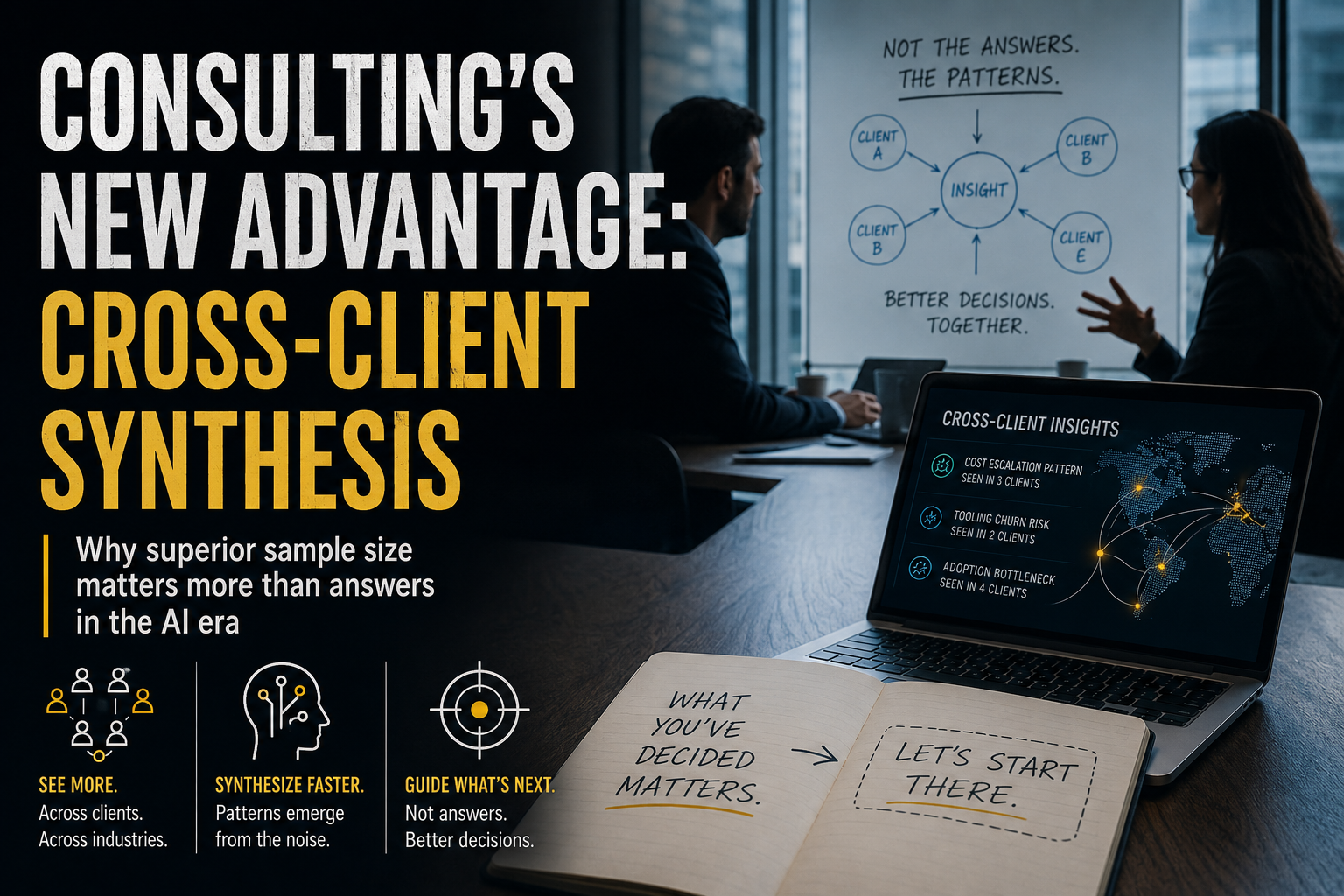
The consultant’s value isn’t superior knowledge; it’s superior sample size.
In a domain where everyone is learning in real time, sample size compounds fast.
That’s a different pitch than the traditional model. Not “we have the answers” but “we’ve seen more attempts, in more contexts, and we can tell you which patterns are showing up across them.” That’s honest and useful.
The People This Requires
This model only works with a specific kind of practitioner. Deep knowledge of a stable domain isn’t the asset here. What matters is learning fast, synthesizing across contexts, and applying patterns before they’re fully settled.
That’s a different profile than traditional consulting has often selected for. It favors people who are more interested in figuring things out than in projecting certainty — who can tell the difference between uncertainty that needs to be managed and uncertainty that just needs more time, and who can turn an early signal from one client into a useful question for another.
The consultants who thrive in this environment aren’t the ones who arrive with the framework. They’re the ones who can build one in real time from what they’re observing across engagements.
Domain knowledge is a force multiplier on top of this. A consultant who also understands the regulatory constraints of healthcare, or the margin dynamics of a specific business model, can apply cross-client patterns with a precision that a generalist can’t. That combination is what’s hard to replicate.
The New Posture
The engagement model has to match the environment. That means faster feedback loops: more frequent check-ins calibrated to how quickly the client’s situation is changing, not to the rhythm of a project plan. It means saying “what you’ve already decided matters more than what we planned to discuss, so let’s start there.” It means being clear that the value is synthesis and pattern recognition, not certainty on arrival.
It also means being honest when a client is about to make a mistake you’ve seen fail elsewhere, even if the right answer isn’t fully worked out yet. “We’ve seen this approach create problems in two other contexts, and here’s what went wrong” is more useful than a confident recommendation built on thin experience.
For consultancies: stop leading with certainty you don’t have. Lead instead with what you’ve seen — what worked in one context, what failed in another, and what questions the client hasn’t thought to ask yet. That includes the uncomfortable job of slowing clients down when they’re moving fast in the wrong direction, even when they’re confident they’re right.
For clients, it means asking different questions. Instead of “what do you recommend?” try “what have you seen fail, and why?” Push back when the confidence isn’t backed by comparable experience. The consultant who can answer those questions honestly is worth more than the one who arrives with a polished framework and no real attempts behind it.