Getting AI to produce consistent outcomes across a large program is hard. Most teams are discovering this the wrong way: each developer finding their own workflow, context evaporating between sessions, features drifting from intent, and no two teams using AI the same way.
Before you can solve it at the program level, you have to solve it at the team level. That’s what this post is about.
The mechanism is a chain of artifacts (PRD, TRD, ADR) that give AI the context it needs to produce work that’s predictable, reviewable, and consistent with what the rest of the program is building. None of this is new. What’s new is the cost of skipping it.
For decades, the case for these artifacts was a discipline argument: do it because it’s professional, because future-you will thank you. The return was real but diffuse. Now it’s immediate.
A clear artifact produces better output the moment an agent consumes it.
A vague one produces vague work just as fast. The cost of ambiguity moved from “someday” to “this sprint.”
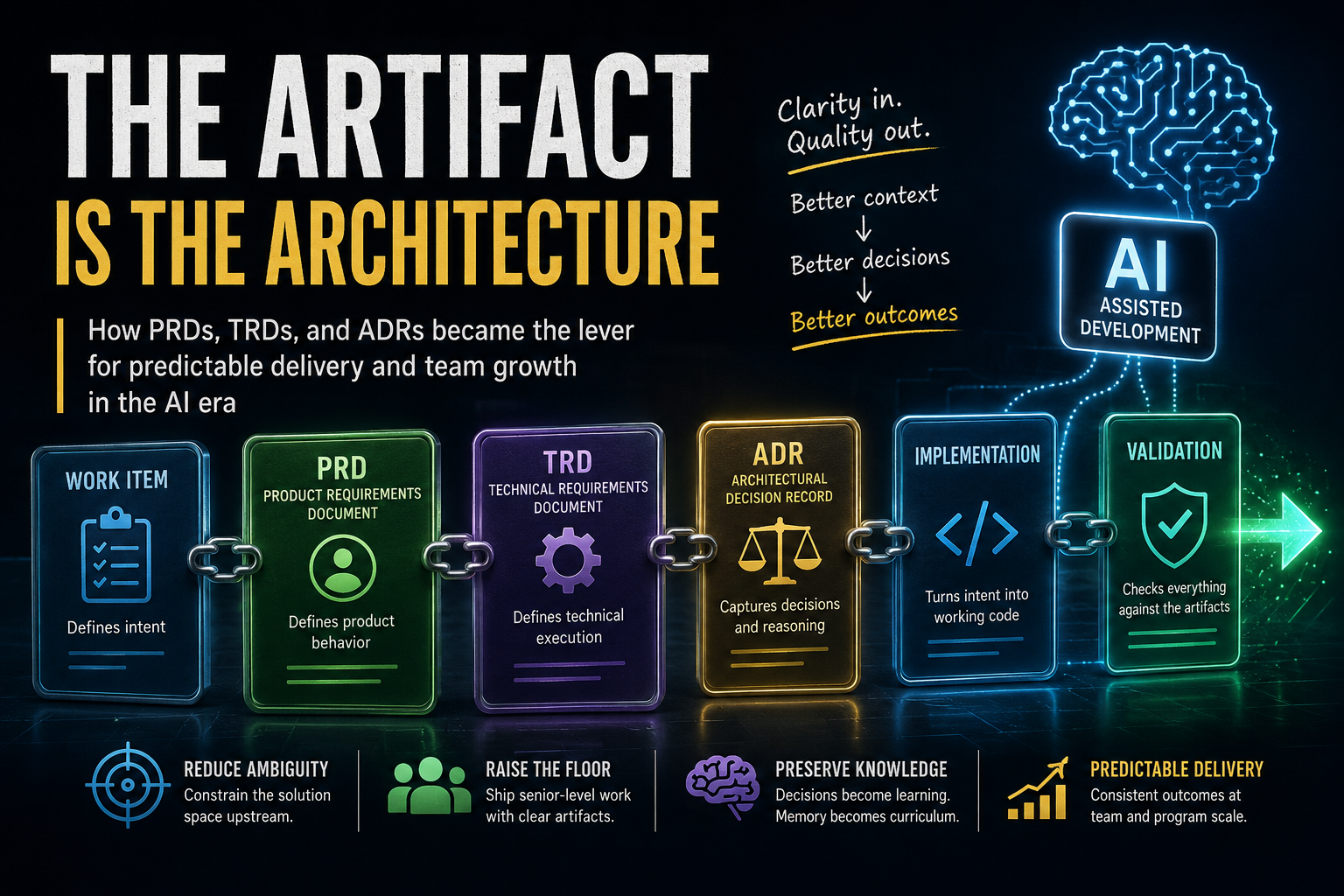
A Chain Where Ambiguity Compounds
The modern AI-assisted lifecycle increasingly looks like this:
Work Item → PRD → TRD → ADR → Implementation → Validation
It’s less a set of documents and more a dependency chain. Each stage feeds the next, and each one consumes what came before. This is a dependency order, not a phase gate. You might draft the PRD, TRD, and a first implementation in a single afternoon, looping between them.
- The work item defines intent.
- The PRD — product requirements document — defines product behavior.
- The TRD — technical requirements document — defines technical execution.
- The ADR — architectural decision record — captures decisions and their reasoning.
- Implementation turns it into code.
- Validation checks all of it against the artifacts above.
The important property of a chain is that weakness propagates. A vague work item produces a thin PRD, which produces an underspecified TRD, which produces an implementation that drifts. Ambiguity doesn’t stay contained. It compounds downstream.
The best way to see this is to follow one feature down the chain.
One Feature, Down the Chain
Start with a typical ticket:
“Add the ability for users to export their account data.”
Hand that to an agent and watch it guess. Which data? What format? Synchronous or a background job? What about large accounts, rate limits, the privacy implications of bundling everything into one file? It will make a dozen decisions you never made, and most of them will be wrong for your system.
Now give it a PRD. It defines the product intent: who needs export and why, that the output is a portable archive the user can hand to another service, that “account data” means profile, activity history, and uploaded files, but not internal audit logs. Success means a user can self-serve an export without opening a support ticket.
The guessing narrows. The agent now knows what it’s building and for whom.
Add the TRD. Export runs as an asynchronous job, not a blocking request. The archive is generated server-side, written to object storage, and delivered as a time-limited signed URL. One export per account per hour. The contract is a single endpoint with a documented response schema.
The space of valid implementations just collapsed to a handful.
Add the ADR that records why: async-to-storage over a synchronous download, because exports for large accounts blow past request timeouts and we’d rather not hold a connection open for ninety seconds. Streaming the response was considered and rejected for exactly that reason.
Now the agent isn’t just constrained. It understands the constraint well enough not to “helpfully” reintroduce the synchronous version next sprint.
The implementation that comes out the other end is close to what a senior engineer would have written. Because the senior thinking happened upstream, in the artifacts, where the agent could read it.
Validation Keeps It Honest
In the old model, testing happened mostly after implementation. Now validation can run continuously, and it has something concrete to check against.
Agents can compare implementation against the TRD, APIs against the OpenAPI spec, events against the schema registry, and architecture against the ADRs. This is what keeps the chain from rotting. When the code drifts from the TRD, or someone quietly reintroduces the synchronous export the ADR ruled out, validation catches the gap. The artifacts stay honest because something is continuously checking the work against them.
Documentation that’s enforced is documentation that survives.
What This Does to a Team
Output uplift is not the same as capability uplift.
If the artifacts do the thinking, a developer can ship senior-level work without developing senior-level judgment. You can build a team whose output climbs while its depth stalls. That holds up fine until the artifacts run out: a genuinely novel problem, an edge the ADRs never anticipated, or the day someone has to write the next decision record.
That’s the catch. But the uplift is real, and it runs deeper than speed.
When clarity drives output, a team’s floor rises. A junior developer with a solid PRD, a constraining TRD, and a set of ADRs — plus an agent — can ship work that used to require a senior. The senior judgment didn’t disappear. It moved into the artifacts, and the agent applies it on every task.
And the artifacts don’t just produce the work. They teach. A junior who reads “why Kafka instead of RabbitMQ, and what we gave up to get there” learns reasoning, not just patterns. Your architectural memory turns into a curriculum.
The artifacts should be scaffolding people learn from, not a crutch they hide behind.
The Real Shift
The distance between idea, specification, architecture, implementation, and validation is collapsing. Work that used to span a quarter of handoffs can happen in a tight loop, with agents carrying it between stages.
The teams that thrive won’t be the ones with the cleverest prompts. They’ll be the ones with clear standards, honest decision records, and the discipline to write down what they mean.
Get this right at the team level and you have something replicable. That’s what program-scale AI adoption actually looks like.