For the past two years, the loudest AI-coding story has been vibe coding: non-technical founders shipping MVPs over a weekend, teenagers building SaaS apps after school, product managers prototyping features without filing a Jira ticket. It was remarkable. It was fun to watch. And most senior engineers rolled their eyes.
That phase is over.
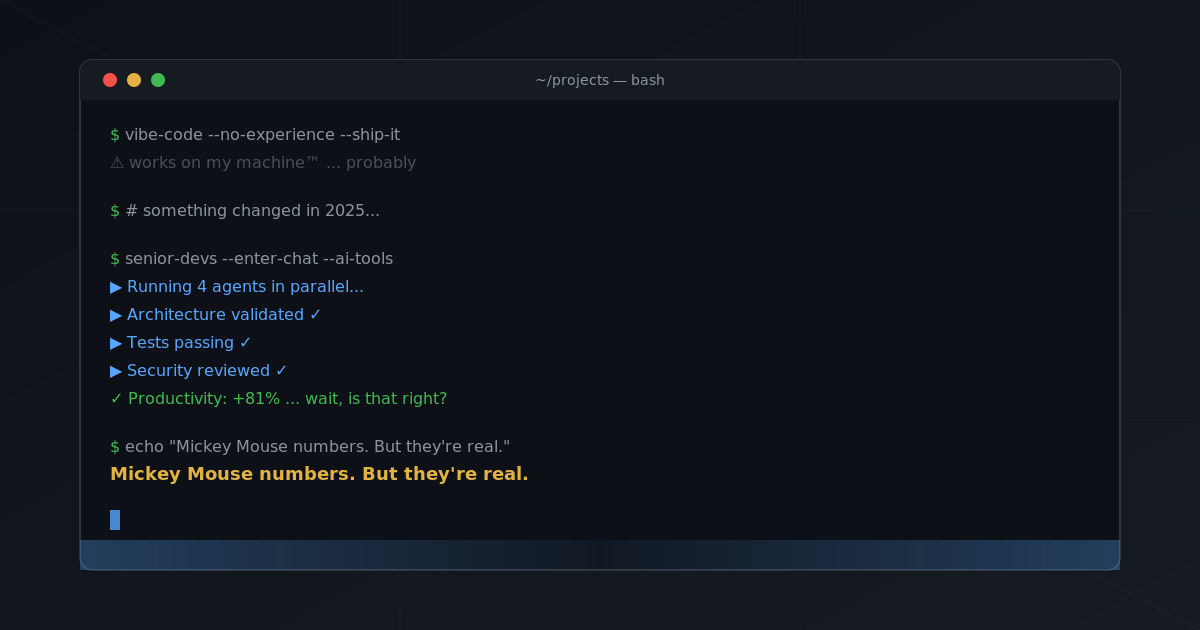
The senior devs have entered the chat. And the numbers they’re reporting sound like Mickey Mouse numbers — the kind of productivity claims you’d laugh out of a pitch deck. Except the people making them have 15-year GitHub histories and opinions about database indexing strategies.
The Skeptics Picked Up the Tools
Something shifted in the second half of 2025. The engineers who’d spent months dismissing AI coding as “fancy autocomplete” quietly started using it. Not for demos. Not for side projects. For production work.
A Fastly survey of nearly 800 developers found that about a third of senior engineers — those with 10+ years of experience — now say more than half their shipped code is AI-generated. That’s 2.5 times the rate reported by junior developers. The people with the most experience are leaning in the hardest.
Why? Because they finally have the one thing junior developers don’t: the judgment to know when the AI is wrong.
Senior developers report 81% productivity gains. They’re running multiple AI agent sessions in parallel — one building a feature, another writing tests, a third doing technical planning. They’re not typing code. They’re directing it. One practitioner described watching Claude Code run autonomous loops — build, test, validate, fix, complete — across four terminal windows simultaneously.
These are Mickey Mouse numbers. They sound absurd. But the people reporting them have battle scars from shipping real systems at scale.
I’ve seen this firsthand — teams that can’t put their real productivity numbers in client proposals because no one would believe them. When your actual data sounds like marketing, that tells you something about the moment we’re in.
Experience Is the Multiplier
Here’s what the vibe-coding era got wrong: it assumed AI would be the great equalizer. Give everyone the same tools and everyone gets the same results.
The data says the opposite. AI is a force multiplier, and what it multiplies is your existing expertise.
Simon Willison drew a useful line when he coined the term “vibe engineering” — distinguishing the fast-and-loose prompt-and-pray approach from what seasoned engineers actually do with these tools. A vibe engineer gives the AI detailed architectural context. They review output with an eye for security, scalability, and maintainability. They know when the generated code “looks right” but isn’t.
This matters because AI coding tools have a specific failure mode: they build what’s quick rather than what’s right. They’ll create the same component five different ways in five different places instead of abstracting it once. They introduce the kind of vulnerabilities that very new programmers make. Catching these problems requires exactly the pattern recognition that takes a decade to develop.
Builder.io put it well: “The ‘10x Engineer’ used to be a myth about a lone genius. In 2026, it’s just an engineer who learned to manage ten agents.”
The Nuance Nobody Wants to Hear
It’s not all upside. A rigorous study by METR found that experienced open-source developers were actually 19% slower when using AI tools on mature codebases — even though they believed they were 20% faster. The tools can create a false sense of velocity while introducing review overhead and subtle bugs.
But that study used early-2025 tools on complex, established projects. The tooling has improved significantly since. And more importantly, the developers who’ve invested in learning these tools properly — building custom workflows, writing good specifications, understanding how to give agents context — are the ones seeing the crazy numbers.
The gap is widening. The engineers who’ve gone deep on AI-assisted development are operating in a different league from those who haven’t. And that gap is going to become very visible in 2026.
What This Means Beyond Code
If you’re a knowledge worker watching the AI conversation with a pit in your stomach, the senior-dev story should give you a different frame.
The narrative has been doom and displacement. But I believe we’re looking at this backwards. When you make work 5x cheaper and faster to produce, you don’t produce the same amount with fewer people. You produce dramatically more. Every organization I’ve ever worked with has an infinite backlog of “we’d love to do that but don’t have the resources.” AI is going to unlock that backlog. My view is that after a painful disruption period, demand for knowledge workers will increase, not decrease — because the scope of what’s worth building will explode.
And the senior dev story reinforces this: deep domain expertise didn’t become less valuable. It became dramatically more valuable. The people who know their craft are the ones extracting the most from these tools.
And if you’re a junior developer reading this, don’t take the wrong lesson. The senior devs hitting these numbers didn’t start out senior. They built that judgment over years of writing bad code, debugging production incidents at 2am, and learning why the “obvious” solution usually isn’t. AI doesn’t skip that journey — it accelerates it. A junior dev using AI tools today can encounter more patterns, more architectures, and more failure modes in a year than previous generations saw in five. The path to seniority hasn’t closed. It’s compressed. But you still have to walk it.
That pattern will repeat across every knowledge profession. The accountant who deeply understands tax strategy. The marketer who can read a competitive landscape. The designer who knows why a layout works. AI won’t replace that judgment. It will give that judgment leverage it’s never had before.
The senior devs aren’t worried. They’re too busy shipping. The smart junior devs aren’t worried either. They’re too busy learning.